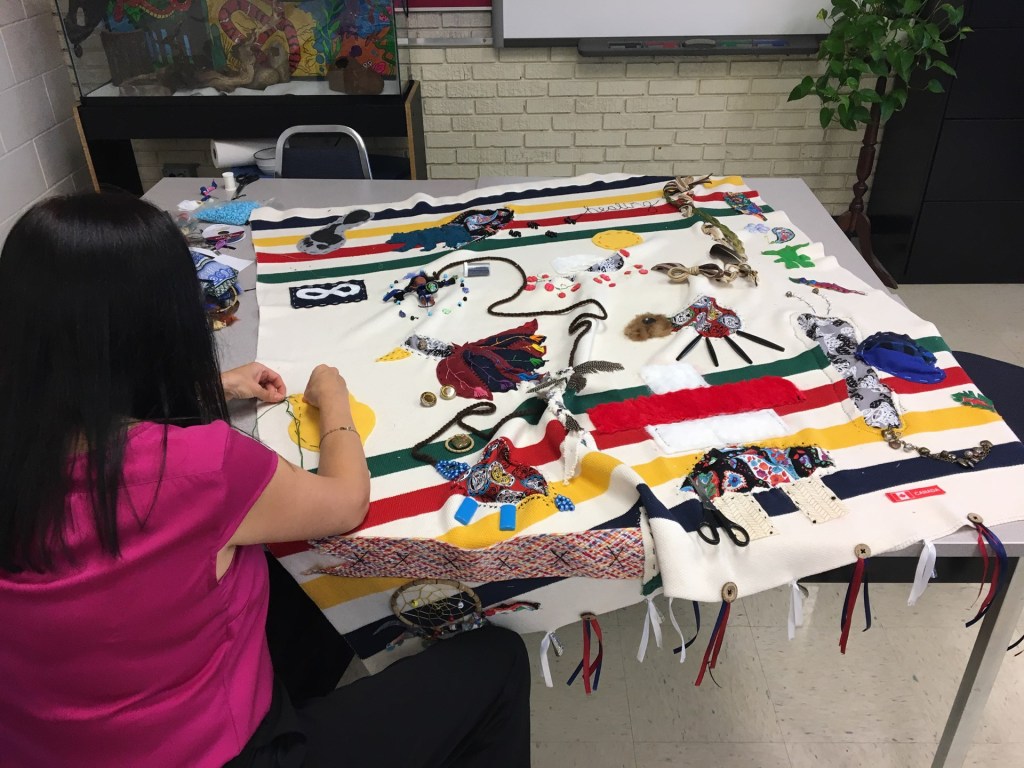
One of the creative and educational experiences that has stayed with me over the years is a reconciliation-based learning project centred on the idea of “mending.”
In this work with students, Hudson’s Bay blankets were used as a starting point for conversation and reflection. The blankets were carefully cut and then repaired through stitching and reconstruction. What began as a physical act of tearing and repair became something much deeper — a way of thinking about history, relationships, and the ongoing work of reconciliation.
As the students worked with their hands, they also worked with questions: What does it mean to repair something that has been damaged? What cannot be returned to its original form? And how do we hold both rupture and care at the same time?
The act of mending became symbolic. It invited reflection on the impacts of colonial history, while also opening space for dialogue about healing, responsibility, and connection. The blankets became more than objects — they became a way of speaking about memory, harm, and the possibility of repair.
For me, this experience reinforced something I return to often in my creative work: that learning is not only intellectual, but also embodied. Sometimes understanding comes through hands, through materials, through the slow and careful act of putting something back together in a new way.
Mending is not about erasing what happened. It is about acknowledging it, sitting with it, and choosing to continue forward with care.